Scientific imaging with the Lytro lightfield camera

Scientific imaging with the Lytro lightfield camera

The Lytro digital camera introduces a Shack-Hartmann configuration into a digital SLR camera.  Why?  For “lightfield” (wavefront) imaging, allowing for depth information in the captured data.  While this kind of thing has long been used for scientific instruments, in particular for laser beam measurements, the Lytro camera brings this capability (and the not insignificant post-processing know-how and hardware required) to photography in the visible.  For rather more detailed information, check out the PhD thesis of Ren Ng, the founder of Lytro.

Here’s a demo image of our VIRP chamber, note that mousing around the image and clicking allows one to change the focus of the image, and the imaging plane.  Mouse wheel to zoom.  It’s going to be an excellent tool for scientific imaging!

* Banner image from Lytro.com.

MPPC test set-up

MPPC test set-up

Some progress for our Direct Ion Detection project: the image above shows the beginnings of a test set-up based around a Hamamatsu MPPC chip, which will be coupled to a scintillator coating to form a complete “direct” ion detection system.  This will then be combined with our VIRP chamber (for rapid vacuum instrument prototyping), allowing us to perform experiments with direct ion detection, and optimise the methodologies and technologies. This is a more refined version of the crude test set-up from a couple of weeks ago!

For further backgournd details, see:
A new detector for mass spectrometry: Direct detection of low energy ions using a multi-pixel photon counter
Edward S. Wilman, Sara H. Gardiner, Andrei Nomerotski, Renato Turchetta, Mark Brouard and Claire Vallance
Rev. Sci. Instrum. 83, 013304 (2012).

Improved direct detection of low-energy ions using a multipixel photon counter coupled with a novel scintillator
Winter, King, Brouard & Vallance
International Journal of Mass Spectrometry, 397–398, 27–31 (2016)

MPPC chips & scintillator coatings

MPPC chips & scintillator coatings

A few images of the in progress testing work for the direct ion detection project.  The images show scintillator coatings, made using the laser dye Exalite 389, and a Hamamatsu MPPC chip to form a complete ion detection system.


For further background details, see:
A new detector for mass spectrometry: Direct detection of low energy ions using a multi-pixel photon counter
Edward S. Wilman, Sara H. Gardiner, Andrei Nomerotski, Renato Turchetta, Mark Brouard and Claire Vallance
Rev. Sci. Instrum. 83, 013304 (2012).

Improved direct detection of low-energy ions using a multipixel photon counter coupled with a novel scintillator
Winter, King, Brouard & Vallance
International Journal of Mass Spectrometry, 397–398, 27–31 (2016)

PImMS camera with VUV light

PImMS camera with VUV light

UPDATE April 2017 – Some of this work is now published, and data is also available, see Time-resolved multi-mass ion imaging: femtosecond UV-VUV pump-probe spectroscopy with the PImMS camera for details.

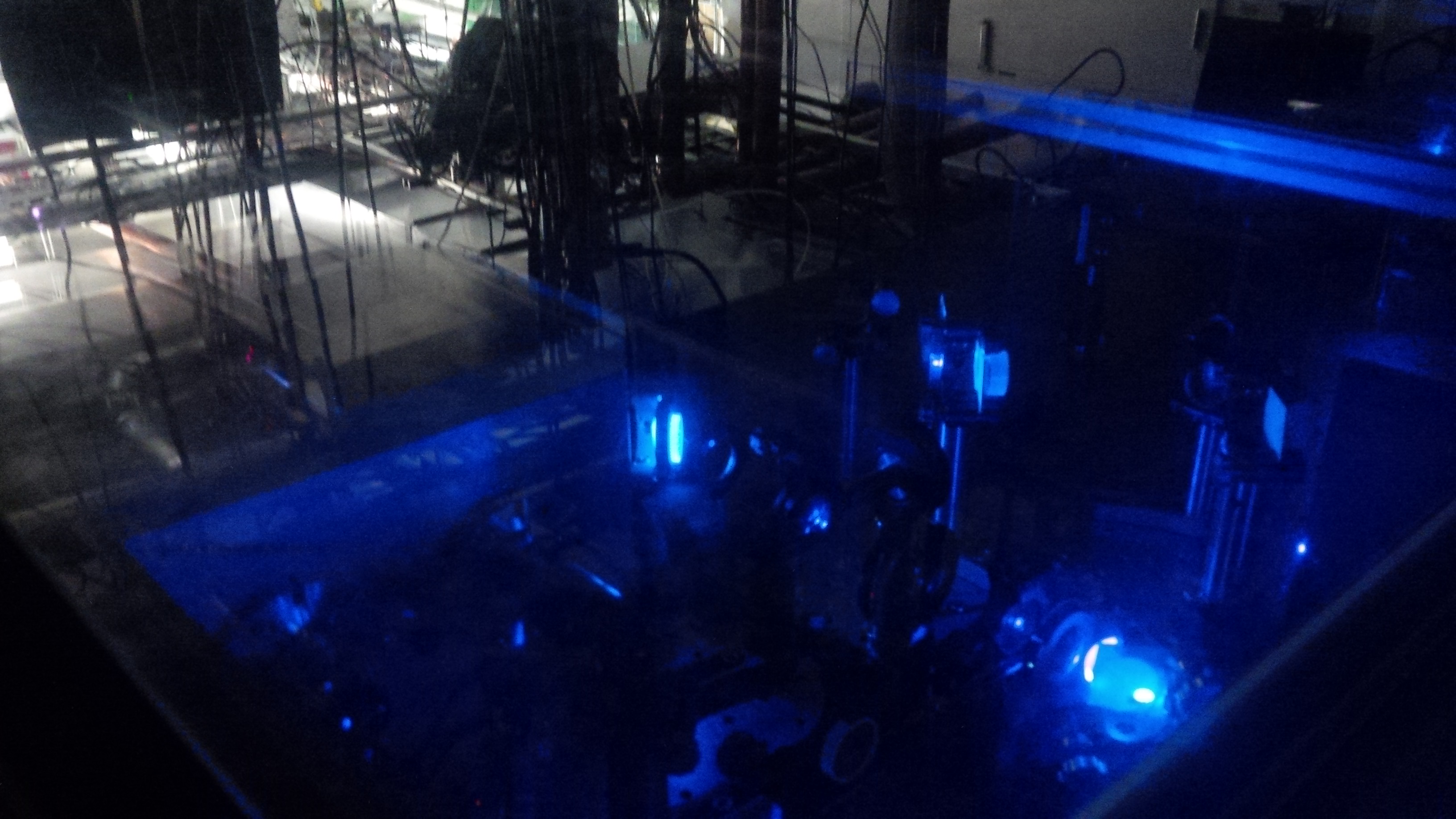
Last week was a busy week, with Prof. Claire Vallance (and two colleagues) visiting to help with technology transfer for our Direct Ion Detection project, based on their previous work in this area. As well as preparing some scintillator coatings, we also had the opportunity to try out another flavour of the new detector technologies they’ve been developing, in the form of the time-resolved PImMS camera. The goal for future detector development is to combine these technologies for a single, on-chip, ion detection solution.

The images below show the camera attached to our velocity-map imaging (VMI) chamber and VUV source.


Vacuum sublimation coatings

Vacuum sublimation coatings

Last week was a busy week, with Prof. Claire Vallance (and two colleagues) visiting to help with technology transfer for our Direct Ion Detection project, based on their previous work in this area. Some scintillator coatings, using the laser dye Exalite 389, were successfully prepared. The video shows this (very basic!) coating technique in action, and the image above shows one of the results, under the microscope. This coating will be combined with a Hamamatsu MPPC chip to form a complete ion detection system.

Vacuum sublimation in progress from femtolab.ca on Vimeo.

For further details, see:
A new detector for mass spectrometry: Direct detection of low energy ions using a multi-pixel photon counter
Edward S. Wilman, Sara H. Gardiner, Andrei Nomerotski, Renato Turchetta, Mark Brouard and Claire Vallance
Rev. Sci. Instrum. 83, 013304 (2012).

Improved direct detection of low-energy ions using a multipixel photon counter coupled with a novel scintillator
Winter, King, Brouard & Vallance
International Journal of Mass Spectrometry, 397–398, 27–31 (2016)

VIRP Chamber: Vacuum Instrument Rapid Prototyping

VIRP Chamber: Vacuum Instrument Rapid Prototyping

The photographs above show our new Vacuum Instrument Rapid Prototyping (VIRP) chamber. The chamber is based around hardware from Kimball Physics (with a company motto that we can all agree with: to advance humankind by doing good physics), which provides a basic construction framework for vacuum instrumentation.

Combined with home-built parts and active components for measurement and control, the VIRP chamber should provide us with a great test-bed for prototyping new instrument designs and testing new detector hardware, as well as provide the full gamut of basic vacuum equipment testing capabilities.

The first configuration for the VIRP chamber consists of a basic Wiley-McLaren time-of-flight (ToF) instrument. This basic ToF mass spectrometer will be used with a femtosecond laser source for the development of new “direct” ion detection technology, in collaboration with our colleagues at the Oxford University (UK), and the PImMS consortuim, starting from their existing work in this area.

For further details, see:
A new detector for mass spectrometry: Direct detection of low energy ions using a multi-pixel photon counter
Edward S. Wilman, Sara H. Gardiner, Andrei Nomerotski, Renato Turchetta, Mark Brouard and Claire Vallance
Rev. Sci. Instrum. 83, 013304 (2012).

Improved direct detection of low-energy ions using a multipixel photon counter coupled with a novel scintillator
Winter, King, Brouard & Vallance
International Journal of Mass Spectrometry, 397–398, 27–31 (2016)

Reading today…

Reading today…

Time‐of‐Flight Mass Spectrometer with Improved Resolution

Rev. Sci. Instrum. 26, 1150 (1955); http://dx.doi.org/10.1063/1.1715212


An oldie, but a goodie, from 1955.  A great primer for time-of-flight mass spectrometer design, and the introduction of space-focussing field design.


wiley-maclaren